Fountain Pen Ink vs. Dip Pen Ink: What Works in Which Well?
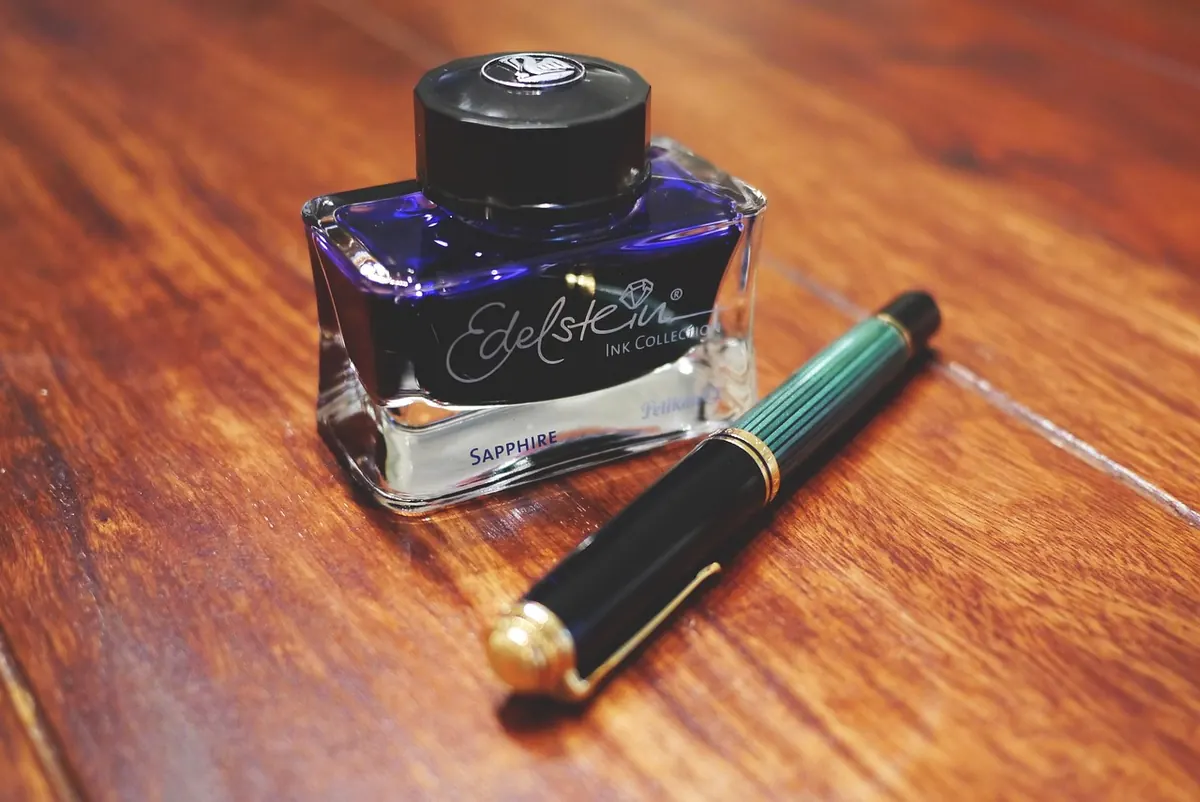
An inkwell is only as good as the ink you put in it, and the two families of ink that live on most desks behave nothing alike. Fill a fountain pen with dip pen ink and you will spend the evening flushing a feed with a bulb syringe. Fill a wide dip well with fountain pen ink and you will watch it run off the nib before you reach the paper. Neither ink is superior; they were designed for different mechanisms. Once you know which is which, the choice stops being a guess.
A fountain pen moves ink by capillary action. The ink sits in a reservoir — a cartridge, a converter, a piston — and is drawn along a narrow slit in the nib, past a feed with a series of fins that regulate flow. The whole journey depends on a thin, freely moving liquid with nothing in it that can settle, dry hard, or form a film. Most fountain pen inks are essentially water with dyes, a little humectant to slow drying on the nib, and a surfactant to keep the flow even.
A dip pen works the other way around. There is no reservoir and no feed: a small pool of ink clings to the underside of the nib by surface tension, and you write until it runs out, then dip again. Because the ink never has to travel through a channel a fraction of a millimetre wide, it can be thicker, more heavily pigmented, and full of binders that would wreck a fountain pen.
Fountain pen ink is formulated to be boring in the best sense: predictable flow, no sediment, nothing left behind. Dye-based inks dominate because dyes dissolve completely. Modern iron gall inks from established makers are usable in fountain pens with a little extra cleaning discipline, and a number of pigment inks are explicitly formulated for fountain pens — the particles are milled fine enough to pass through a feed rather than clog it. Those still deserve more frequent flushing than a plain blue.
What should never go near a fountain pen:
The damage is not always instant. Sometimes the pen writes happily for a week, then starts skipping, and by the time you take it apart the feed channels are furred with dried binder. A clogged feed can often be rescued with a long soak and repeated flushing, but shellac and acrylic can be permanent.
Dip pen inks are made to sit on a nib, so they are usually thicker and carry more colour. Many are waterproof, which is the point when you are addressing envelopes or drawing; that waterproofing comes from shellac, acrylic resin, or a heavy pigment load — all things a fountain pen dislikes. You will also meet iron gall calligraphy inks, walnut ink, and gouache you mix yourself, none of which belong in a feed.
If your nib has a metal reservoir clipped underneath, or a bowl-shaped Speedball nib, a thicker ink works beautifully and a very thin one will simply run past the reservoir and pool on the paper. With a plain pointed nib, a slightly thinner ink gives cleaner hairlines in flex writing. That is why pointed-pen calligraphers often reach for fountain pen ink while broad-edge and drawing work wants something heavier.
You want a narrow neck, a tight seal, and modest capacity: glass with a ground stopper, or a screw cap with a sealing liner. The mouth should be deep enough to submerge the breather hole without swallowing the grip section, which then needs wiping. Dark glass, or a drawer, slows light damage. When a bottle runs low, don't tilt and hope — draw the last millilitres out with a syringe into a clean vial, or fill a converter directly.
A wide mouth, a shallow interior, a heavy base, and a lid that actually seals. Fill to about a centimetre: enough to cover the nib tip, not enough to drown it. Ink sitting on top of the nib above the slit just makes a mess and drips. Some dip wells have a sloped floor or a small brush to regulate how much ink the nib picks up, both worth having if you write for long stretches. If your well is deep, drop in a few glass marbles to raise the level.
Often, yes. Fountain pen ink in a dip pen is thin, so it drips from the nib and you re-dip more often, but it gives lovely hairlines and cannot clog anything. Several fountain-pen-safe pigment inks also hold up well on both sides of the desk.
The reverse is not worth attempting. And be careful with the old trick of adding gum arabic to fountain pen ink to thicken it for dipping: it works, but the result is no longer fountain-pen safe. Mix it in a separate small pot, keep that pot for dip work only, and never pour the mixture back into the original bottle.
Two inkwells — a small lidded one for filling, a wide one for dipping — plus a syringe, two or three small glass vials for decanting, a bulb syringe for flushing, a folded lint-free cloth, and a shallow box in a drawer for the bottles you are not using this month. Keep the box dark and upright, and write the opening date on each label.
Then build one habit: flush any pen that has been in rotation for about a month, and always flush before you change ink. It takes ten minutes and saves you the evening you would otherwise spend coaxing a feed back to life. Choose the ink for the tool, the inkwell for the ink, and both setups will simply work.
Photo: LUM3N / Pixabay
Previous Post
Inkwell Care Checklist: Cleaning, Storing, and Refilling Without Stains
Next Post
How to Build a Compact Stationery Drawer That Actually Stays Tidy