How to Build a Compact Stationery Drawer That Actually Stays Tidy
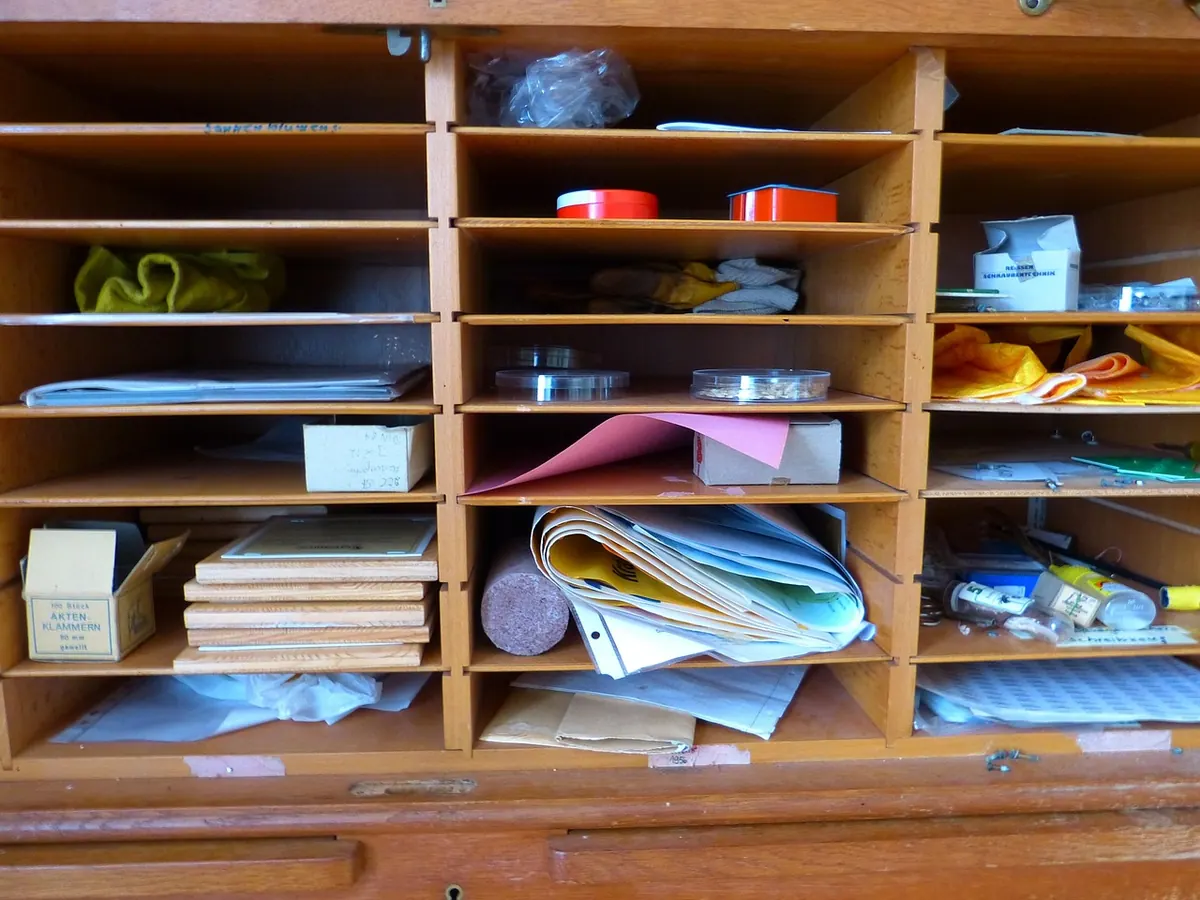
There is a particular kind of drawer that starts out full of promise and ends up a tangle of orphaned pens, loose paper clips and three pairs of scissors that no longer cut. It is almost always the small one beside the desk — the one you open twenty times a day. A compact stationery drawer does not need more space. It needs a few decisions made once, a simple grid that holds those decisions in place, and a set of habits that take ten seconds to keep.
Take everything out. Not most of it — everything, down to the last pushpin rattling in the corner. Tip it onto a tray or a sheet of newspaper so small items cannot roll away, then wipe the drawer with a damp cloth and let it dry while you work.
Now sort into four piles, and be strict about the fourth:
The finished pile is usually bigger than expected. A dried-out marker in the drawer costs you something every time you pick it up and put it down again. Let it go.
Before you buy or build anything, measure the inside of the drawer: width, depth and, most importantly, height. Write those three numbers on a sticky note and keep it with you. A divider set that is two centimetres too tall is useless, and a drawer that will not close is worse than one that is merely untidy.
You do not need a custom insert. You need something that stops objects sliding into each other, and that can be lifted out for cleaning. Three approaches work well in small drawers:
Whichever you choose, leave a little slack. Compartments that grip too tightly are hard to clean, and a drawer you avoid is a drawer that fills with clutter. A gap of a few millimetres at the sides lets you slide a finger in and lift a section out.
A drawer sorted by manufacturer looks beautiful in photographs and fails in daily use. Sort by the moment you need something instead, then place each group where your hand naturally lands.
In practice, most small stationery drawers hold five workable groups:
If a group will not fit, do not squeeze it. Move the technical items to a box on a shelf and keep the drawer for what your hand reaches for. The drawer's job is speed, not storage capacity.
Once the groups exist, arrange them in bands. The front third of the drawer belongs to the daily group — that is the zone you can reach without looking. The middle band takes marking and paper. The back takes refills, the stapler and anything you use weekly at most.
Two practical rules save a great deal of frustration:
If there is only room for one layer of pens, use a two-layer trick: a slim sliding tray for the items you use least, resting on low battens fixed to the drawer sides, with the daily items underneath. Alternatively, split the drawer lengthwise — scissors and ruler down the left channel, writing tools in the middle, sticky notes at the right. Long, narrow compartments use shallow space far better than a grid of small squares.
A layout survives only if it is easier to follow than to ignore. These habits cost almost nothing:
One more rule earns its keep: set a cap on duplicates. One pen in use, one spare. One tape dispenser. When a new notebook comes home, an old one leaves.
No drawer stays perfect, and it should not have to. If your compact stationery drawer starts to slide after a few weeks, the usual cause is a single mismatched zone — the scissors that never quite fit, the refills block you have to dig past. Fix that one compartment rather than reorganising everything. Change the divider position, move the group to the back, or move it out of the drawer entirely.
The measure of success is simple: you open the drawer, your hand goes to the right place, and you close it again without thinking. When that happens, the system is working, and upkeep becomes a minute here and there rather than a project you keep postponing.
Photo: LoggaWiggler / Pixabay
Previous Post
Fountain Pen Ink vs. Dip Pen Ink: What Works in Which Well?
Next Post
The Beginner's Guide to Letter Writing with a Dip Pen